Baseball’s “Culture” Once Again Rears Its Ugly Head

Photo Credit: Ronald Martinez/Getty Images

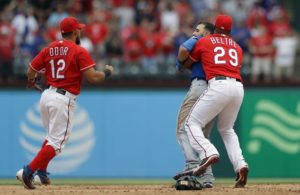
You’re probably aware of this by now, but Jose Bautista got punched in the face yesterday.

The blow was the result of a hard slide into second base that attempted to break up a potential double play.  The slide would result in an out because of the new rules regarding interference at second base; however, the result of the slide would be what we’re talking about today and what we’ll be talking about for a long time.

The inning started with this pitch from Matt Bush that drilled Joey Bats squarely in the elbow.  The intentions of the pitch are debatable but you can see it for yourself here:

An Edwin Encarnacion fly out would be the first out of the inning. Jake Diekman subsequently entered the game and induced a ground ball to second from Justin Smoak.  And that’s when all hell broke loose.  (WARNING: video may be disturbing for some.)

Odor landed a right hook to Bautista’s face that would qualify as a knockout punch.  A full-blown donnybrook broke out, and Bautista, Odor, and Josh Donaldson were ejected after the fight.  It was a legitimate brawl; far from the usual baseball “fight” that consists of players running in from the bullpen and both dugouts only to stand around and yell at each other.

After the fight in the top of the 8th, Jays reliever Jesse Chavez thought it an intelligent idea to plunk Rangers DH Prince Fielder in the back to start the next half-inning.  It wasn’t.  Both benches cleared again and Chavez was ejected.  The Rangers ultimately won the game, 7-6. Nobody cared.

With all of this having occurred, one would think that the reaction to the fight would be negative.  One man punching another in the face is not generally well-received; just ask LeGarrette Blount.

Instead, some of the headlines and reaction were comparatively positive.  These are just a couple of the reactions to yesterday’s scuffle:

Deadspin: Blue Jays Call Rangers “Gutless” And “Cowardly” After Excellent Brawl

CBS Sports: WATCH: A montage of best right-handed punches in history of MLB fights

That reaction is real; people (even some involved in baseball) really think that throwing punches is cool.  In any other civilized setting, this action would be denounced as boorish and unethical behavior. In hockey, it’s called Tuesday, but fighting isn’t right in that sport, either. That being said, at least hockey players have some protection in the form of their helmets and the fight is at least somewhat controlled, often only involving one-on-one combat.  It doesn’t justify fighting, but it does explain why hockey continues to allow it, even as findings regarding concussions and brain injuries suggest that it should be banned.

That being said, how can baseball legislate its fighting problem?  It won’t be easy and it can’t be done by the umpires on the field.  It can be done on Park Avenue, by Rob Manfred and Major League Baseball.

One way to start would be to hand out major, major suspensions for this ridiculous brawl.  The MLB record for the longest suspension after a fight is 10; that record is jointly held by Michael Barrett, Ian Kennedy, Mike Sweeney, Miguel Batista, and Runelvys Hernandez. They were all suspended for some pretty wild actions, but it’s difficult not to argue that Odor’s right hook belongs up there with those fights as the most violent in baseball history.

This is another reason why there needs to be severe punishment for those involved in the fight: baseball needs a culture shock.  It needs to realize that fighting fire (or lesser things) with fire isn’t the right thing to do, that retaliation and violence are not avenues to deal with conflict over the course of a game.  Giving massive suspensions to Odor and others for their roles, even if they are unprecedented, can go a long way in changing baseball’s “eye-for-an-eye” culture.

But baseball must do even more to prevent fights like this from happening in the future.  One way the sport can stop the problem from growing is to educate its players on the dangers of violence and the serious harm that their actions can cause others.  Yes, players still will instinctually turn to brawling to deal with issues that arise, but if they are properly educated on the cons of these fights rather than the pros, the game will be far better for it.

And we can’t forget the elephant in the room: Jose Bautista’s actions in last year’s playoffs.  In a winner-take-all ALDS game 5 between these same two teams, Bautista launched a 7th-inning bomb to put the Blue Jays ahead to stay and into the ALCS.  Merely seconds after he made contact, Bautista launched quite possibly the most memorable bat flip throw in MLB history:

Some predictably took affront to Bautista’s actions, saying that he went over the top in his reaction to his home run.  For me, it’s very difficult to take issue with what Bautista did; it was the biggest home run of his life.  If you were him in that moment, you would celebrate too.  We need to stop having issues with bat flips and embrace them as a way of expressing the pure joy of this wonderful game; if we do this, we can make baseball fun again.

Finally, the last issue with baseball’s old school culture is that it is self-righteous and ignores the past actions of certain players if they play the game “the right way”.  For example, Odor has pulled plenty of dirty slides over the past year, as Padres pitcher Brandon Morrow points out:

And that’s not all when it comes to the second baseman.  In 2011, Odor was playing for the Spokane Indians of the Northwest League. On a play eerily similar to the one on Sunday, Odor slid well past second base.  After running in awfully close proximity to the Vancouver Canadians’ second baseman, a big fight like Sunday’s broke out, leaving Odor to fight the entire Vancouver team on his own:

So it’s only fitting that Odor was involved in the biggest MLB brawl in recent memory.

Baseball needs a change of culture, and it needs one soon.  The sport needs to relax its harsh critiques of bat flips, flamboyance, and harmless emotion so it can refocus its gaze on the very dangerous violence that sometimes exists between the white lines. Unfortunately, it may take a serious injury in one of these conflicts to make the sport change its ways.

However, baseball should change before we get to that point.

Capital Loss: Washington Blows Its Last, Best Chance at a Stanley Cup

Photo Credit: Charles LeClaire/USA Today

These weren’t the same old Capitals, they said.  This year would be different, they said.  Have faith in Washington, they said.  This team and these players would finish the deal, they said.  The Capitals would win a Stanley Cup, they said.

And yet, here we are, in the same position we were in years past, questioning what went wrong in Washington and what can be changed for the future.  And yet, maybe the Capitals have passed the point of no return, blowing their best chance to date at finally getting over the hump.

This year, the Capitals had the best season in hockey, amassing 120 points and 56 wins en route to the Presidents’ Trophy and home-ice advantage throughout the playoffs.  For a time, they even flirted with NHL records in points (132) and wins in a 70+ game season (62).  The points record is held by the 1976-77 Montreal Canadiens; the wins record resides in Detroit with the 1995-96 Red Wings.  The Canadiens won the Stanley Cup in 1977 while the Red Wings lost to the Avalanche in the 1996 Western Conference Final.  The 2015-16 Washington Capitals wouldn’t even get that far.

In hindsight, the first harbinger of trouble in the Caps’ truncated playoff run was their first-round series against the Flyers. Washington jumped out to a 3-0 lead in the series before dropping games 4 and 5.  The game 5 loss stands out in particular because the Capitals outshot the Flyers 44-11… and lost 2-0.  The team would take game 6, but the damage had been done.  The league’s best team was proven vulnerable.

After advancing over Philly, the Capitals would face the Pittsburgh Penguins in the next round.  The series was competitive and riveting; five of the six games were decided by one goal and three of six games went to overtime.  The first game was one of those overtime tilts, and the Capitals won it on this T.J. Oshie goal that almost didn’t make it across the goal line:

Game 2 also went down to the wire, with Eric Fehr’s goal at 15:32 of the 3rd period giving the Penguins a 2-1 victory.  A 3-2 win in Game 3 put the Penguins up 2-1, and Pittsburgh would take a 3-1 series lead on the strength of this overtime goal from Patric Hornqvist at the end of Game 4:

Game 5 saw the series return to the Nation’s Capital and the Capitals win 3-1 to force a Game 6.  In that game, Pittsburgh would pull out to a 3-0 lead and hold a 3-1 advantage going into the third period.  At this point, Capitals fans must have been simultaneously thinking the same thing: “Here we go again.”  However, this team was supposed to be different, the squad to avenge the losses of the Capitals’ past.

And while they couldn’t avenge those past losses just yet, the Capitals were able to avenge their bad start and tie the game at three with goals from Justin Williams and John Carlson.  This one would also go to an extra period; would the outcome be different for this year’s Capitals?

We got our answer at 6:32 of the first overtime period. Nick Bonino scored this game-winner on assists from Carl Hagelin and Phil Kessel to win the series for the Penguins and send the Capitals golfing:

Here’s the question, though: what happened?  Why didn’t things change from prior years?

First of all, the Capitals didn’t choke.  I say that mainly because I absolutely hate the use of the word in sports.  The amount of proverbial or actual “choking” that goes on in sports is much less than you would think, especially if you only get your news from those who refuse to look at the facts.  That being said, the Capitals’ failure does represent a rather enormous missed opportunity, one that may haunt the organization for years to come.

This is why: Alex Ovechkin isn’t getting any younger.  At 30, he’s the best player in the game of hockey, but he’s also coming into the twilight of his prime.  Wayne Gretzky’s play began to decline around the age of 31; that isn’t meant to compare Ovie to the Great One, but it does show the mortality of NHL players, especially as the physicality and energy of the game takes a toll on their aging bodies.

Another reason why this is such a big disappointment is that the team is built to win in the postseason.  Yes, Ovechkin is the best player in the game, but goaltender Braden Holtby might be the best netminder in hockey right now.  Holtby is a nominee for the Vezina Trophy, annually given to the best goaltender in the NHL.  One of the major keys to victory in the playoffs is having a solid, consistent presence in net, and the Caps have one of the best goalies you could ask for.

And while he gave up four goals in the team’s final defeat of the season, Washington’s elimination can hardly be blamed on him.  By Goals Against Average, total saves, and save percentage, Holtby was the best goalie in the playoffs.  While other netminders had better and more efficient statistics, they didn’t have to deal with an unceasing barrage of shots in their general direction; Holtby did.  Even though he didn’t get the results to match his play, he is hardly the reason the Capitals are going home so early.

Are the Capitals cursed?  It’s difficult to say; they definitely are far from lucky.  The comparisons between them and the Clippers and, more specifically, Alex Ovechkin and Chris Paul, are stunning. Neither player has made the Conference Finals of his sport, and neither star is at fault for his team’s repeated misfortune.

That being said, the Capitals must recover quickly from this defeat. They’ve gone down time and time again early in the playoffs, so coming back from bitter defeat at the end of seasons is nothing new for them.

However, it may be too late for the current version of the Capitals to seize the sport’s ultimate prize: the Stanley Cup.

Where Does He Go Now? The Future of Frank Vogel

Photo Credit: Associated Press

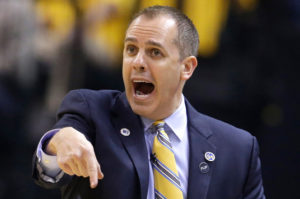
Frank Vogel is one of the best coaches in the NBA.  He’s an intelligent, charismatic team builder who has molded the Indiana Pacers into one of the most consistent teams in the league.  He’s also out of a job.

After coaching Indiana to five playoff appearances in nearly six years as the team’s head coach, he was let go by team president Larry Bird because… well, I don’t know why:

“Good coaches leave after three years”.  Larry Bird is the one of the best basketball players ever; what some forget is that at one time, he was a pretty good NBA head coach.  Ironically, he led the Pacers to three straight playoff appearances and the franchise’s only NBA Finals appearance in 2000.  Indiana lost to the Lakers, ending Bird’s third season as head coach.  And then…. he left.  Irony.

That being said, Vogel will have plenty of options if he wants to coach next season.  Let’s look at a few of those here.

Honorable Mention: Portland Trail Blazers

Yes, it sounds crazy; the Blazers already have Terry Stotts, one of the best coaches in the game and the runner-up in this season’s Coach of the Year voting.  Stotts, however, is at the end of his contract and while a deal should still get done, it will be interesting to follow whether this team and its coach come to an impasse in negotiations like the one encountered by Vogel and the Pacers.

It’s not likely that this job will be open, but it’s definitely one worth watching.

New York Knicks

Let’s just skip the formalities: there’s no chance Frank Vogel is coaching the Knicks next season.  They’ve seemingly locked in on Kurt Rambis as their guy (for some reason) and aren’t conducting much of a coaching search right now.  Vogel actually grew up in Wildwood, New Jersey and worked for the Lakers and Phil Jackson as an advance scout during the 2005-06 season.

Also, remember that Jackson, the team’s president, waited until June 10, 2014, before hiring Derek Fisher as its head coach the last time the job was open.  Vogel won’t last until then for the seemingly unhurried executive.  The likelihood of Vogel coaching the Knicks next season is easy to figure: zero.  There’s no chance of this actually happening.

That being said, it is fun to imagine the Knicks making a good coaching hire, for once.

Houston Rockets

This one is really interesting.  The Rockets have a superstar in James Harden who, believe it or not, is only 26 years old.  Ironically, Paul George is also 26, and we saw what Vogel was able to do for him.

However, the problem with this move would be the Pacers’ and Rockets’ respective paces and styles of play.  While Vogel’s Pacers have averaged just over 93 possessions per game over the past four seasons, the Rockets have been successful by pushing the pace and garnering more possessions.  In fact, Houston has eclipsed 96 possessions per game over that same time period, outrunning Indiana… but not necessarily outplaying them.

The teams have basically had the same amount of success over the past four years, with the Rockets making the playoffs every year. However, the Pacers have found more success in the second season, with two Conference Finals appearances in 2013 and 2014 and a seven-game first-round series with the Raptors this year.  The Rockets, on the other hand, have been eliminated in the first round in three of the past four seasons with a Conference Final appearance and a quick exit at the hands of the Warriors wedged in between.

Also, there’s the minor issue of the Vogel’s style of play and, more significantly, the ability of the Rockets’ personnel to hypothetically carry it out.  Dwight Howard has an opt-out clause that he can use this July 1; needless to say, he won’t be back after the tumult of this past season.  With his imminent departure, the Rockets are looking square in the face of starting Clint Capela at center unless, of course, the team can sign or draft a big man this summer.  Vogel’s Indiana teams had the most success when his offense was allowed to run through David West and Roy Hibbert, each of whom was one of the best big men in the game at one time.

Much was made of the Pacers’ going small and playing faster this season; while it worked for one year, there is no doubt that Vogel is much more comfortable espousing an old-school, traditional style of play on offense.  The Rockets wouldn’t be able to carry this out in their current form, so something would have to give.

But it sure would be intriguing to see what would happen if Vogel coached the Rockets, even if it would be different than what we’re used to from him.

Memphis Grizzlies

This fit is emerging as the most logical one for Vogel, as Adrian Wojnarowski of Yahoo.com’s The Vertical reports:

The preliminary stages of Memphis’ search to replace Dave Joerger include Vogel – the formerIndiana Pacers coach – who used the weekend to decompress after losing his job on Thursday, league sources said.

Vogel plans to start evaluating head-coaching opportunities early this week, league sources said.

The fit in Memphis makes the most sense for Vogel.  His old-school, slow style of play with a heavy emphasis on big men suits the Grizzlies’ “grit-and-grind” mantra perfectly.  If the team can secure Vogel as its head coach, it won’t have to change its style of play much, if at all.  What the team will have to change is its health, and there’s not much that can be done about that.

This season, the Grizzlies used an NBA-record 28 (!) players en route to a 42-40 record and a first-round sweep at the hands of the Spurs. Key pieces such as Marc Gasol, Mike Conley, Zach Randolph and Tony Allen all missed significant time over the course of the regular season. Also, no player on the team started over 57 games for the team, forcing Memphis to use 28 different starting lineups over the course of the season, with 12 of those combinations starting just one game.

It’s easy to see why the Grizzlies took a step back last season.  None of their best players could stay healthy for the entire year and the continuity of the team’s play was shattered.  That being said, the team could be back to its old ways next season, and new leadership may be part of their potential improvement.  Dave Joerger was almost inexplicably fired after this past season for the team’s subpar performance; now, it’s easy to see why he was canned.

The Grizzlies had something better lined up the whole time.

5,000 to Won: Making Sense of What Leicester City Just Did

Photo Credit: English Press Association

We’ve seen some pretty awesome underdogs in the history of sports, but we’ve never witnessed one quite like this.

Today, these underdogs completed the conquest of their sport and attained what might be the most unlikely title in the history of sports. Yes, the history of sports.

Going into the English Premier League season, nothing very little was expected of Leicester City FC.  That lack of expectation has followed the Foxes since last March; the team was ranked last in the English Premier League with seven games to play last season.  Things were so bad that they were seven points behind the 19th and second to last place squad, facing the very real prospect of relegation to the Football League Championship.  (The bottom three teams in the Premier League are relegated and the top three teams in the Football League Championship are promoted to the Premier League each season.)

However, the team pulled off a miracle, securing 22 points in its final nine games and finishing in 14th place to ensure another season of Premier League football.  As it turns out, the comeback finish would be a harbinger of things to come.

The team was, and you may want to be sitting down for this, 5000-1 underdogs to win the league this season.  We’ll come back to that figure later.

Anyway, the team wasn’t expected to go very far this year.  The odds of their relegation were assuredly greater than those of them actually winning the league.  Despite these slim chances, Leicester got off to a strong start, accumulating 40 points in its first 17 games to top the league table on Christmas.  A winless three-game stretch from December 26 to January 2 dropped them to second, but a three-game winning streak kickstarted by a 1-0 January 13 win over Tottenham Hotspur put the team back on top.  And that’s where they would stay. Tottenham blew a two-goal lead with seven minutes to play and ceded a 2-2 draw to Chelsea today, clinching the title for LCFC.

Impressively, the team would lead the table for a total of 147 nights over the course of the season.  This means that it led for 52% of the year; this certainly wasn’t a wire-to-wire championship, but leading the league for over half the season isn’t bad either.

With all of that being said, the team was a 5000-1 longshot to win the league.  How is it possible that they actually pulled this off?  That we may never know, but it is important to add context to this championship.

For example, the Weber State Wildcats made this year’s NCAA Tournament as a 15-seed.  They would ultimately fall, 71-53, to Xavier in the first round.  As a team in a mid-major conference (Big Sky) that has never had a national champion, you would figure that their odds of winning one next year are pretty long.  They are; according to vegasinsider.com, the team is a 2000-1 longshot to be featured at the end of next season’s edition of One Shining Moment.  The Wildcats still aren’t nearly as big underdogs as Leicester was this year.

The closer you look, though, the worse it gets.  The Cleveland Browns look like they might be one of the worst teams in the history of the NFL this coming season.  They’re a glorified expansion squad, and that is a serious, majority opinion.  The Browns are so bad that they turned to a baseball executive, albeit an analytics guru, to run its front office.  Not to pile on, but the team will probably be an underdog in every single one of its games.  Translated: Las Vegas thinks the Browns will go 0-16.

But do you know what their odds are to win the Super Bowl?  200-1. I’m not sure how that is possible, but that’s the Browns’ chances of winning it all in 2016.  If it’s any consolation, Cleveland’s odds to win the AFC are 100-1.  Let’s do one more of these, shall we?

The Atlanta Braves have been baseball’s worst team so far this season, winning 5 of 23 games in the month of April.  They’ve hit a grand total of five home runs to this point in the season; three of them have come from star first baseman Freddie Freeman.  Atlanta is quite obviously going nowhere this year, and as I write this, the Braves are losing 4-0 to the Mets.

The best part of all of this?  They only face 500-1 odds to win the World Series this season.

The point of this exercise was to demonstrate how disrespected the Foxes were by oddsmakers and pundits going into the season. Relegation was the most likely outcome for the team and anything more would have been considered a pleasant surprise.  But a championship?  That is a complete and utter shock, to say the least.

There have been many memorable, inspiring, and shocking underdog championships in the history of sports.  Some that immediately come to mind are the 1983 North Carolina State Wolfpack, the 1985 Villanova Wildcats, the 2008 and 2012 New York Giants, the 1969 New York Jets, the 1969 New York Mets, and the 1980 U.S. Hockey Miracle on Ice.

This is the difference with Leicester, though: they did it for a full season.  There were no playoffs for the Foxes to win and there would be no getting hot at the right time.  The team would have to be the best team in the Premier League for an entire season, all while having to manage injuries and cold stretches.  All of the aforementioned squads weren’t the best in the regular season and simply played their best at the most opportune time.

It’s hard to win consistently in sports, but to be the best team in the sport for the majority of the season at such long odds is far more difficult.  Leicester City did that and defied every prediction and prognostication in the process.  They also took much of the world by storm, captivating those who may not have been otherwise interseted in the Premier League season.

Not bad for a team that should have been relegated.

Why Athletes Don’t Trust the Media

Photo Credit: AP Images

The Golden State Warriors defeated the Houston Rockets 121-94 on Sunday to take a 3-1 lead in their first-round series.  To many in the city of Houston, though, the game was an afterthought.

Ravaging floods have recently affected the city, killing at least eight and forcing over 1,000 to leave their homes.  The rainfall is a serious matter as it has caused over $5 billion in property damage across the city.  Therefore, you can understand why Houstonians aren’t exactly worried about their Rockets right now.

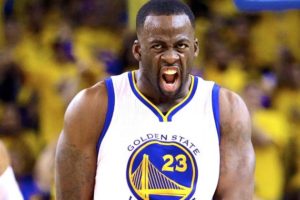
But that didn’t stop a reporter from asking Draymond Green a question about the parallels between the flood and the Warriors’ road wins in the city in each of the past two playoffs.  Instead of deflecting this ridiculous inquiry, Green took the time to wonderfully excoriate whoever this “reporter” is:

The question was easily the dumbest I’ve ever heard.  Trying to create similarities between the team’s 21 threes and a life-threatening natural disaster is never a good way to go about your business as a so-called “journalist”.  Yes, you’re there to ask questions and get more than just cliched responses out of the players, but you’re also supposed to make informed, relevant, pointed inquiries.  That question had none of those qualities.

And yet, upon hearing the tirade, I had a different thought: would it have been better for Green to just say “next question” and move on? Did Green’s destruction of the reporter actually shift attention away from the question and toward the player ranting about it?

We’ve seen reporters ask stupid questions before, especially in the NBA.  During the 2014 NBA Finals, local reporter Bobby Ramos made a name for himself for all the wrong reasons.  After the Spurs’ 111-92 defeat of the Heat in Game 3, Ramos got his chance to question LeBron James and Dwyane Wade.  This is what he asked in his 15 seconds of fame:

I have no idea what Ramos was trying to accomplish by way of that question.  Translated, this is what he asked: “Is the problem that you’re not scoring enough or that you’re giving up too many points?” Basically, it sounded like Ramos wanted to know if it was important for one team to score more points than the other.  In my brief experience with the game of basketball, it is.  But that’s just my perspective.

It was a question that James and Wade wasted little time with.  They both chuckled and Wade answered that the team was down 2-1 and that was the big problem.  Really, huh?  I’m sure that’s a piece of information that fans would not have previously known.

That wasn’t all the press conference fireworks for that series, however.  Before game 4, Spurs coach Gregg Popovich sat down at the podium and fielded this bizarre query from another Miami-area reporter:

While Popovich gets criticized sometimes (and rightfully so) for his excessive brevity with reporters, he did nothing wrong by shooting down this question.  The team was coming off one of the most dominant performances in NBA Finals history in game 3; a repeat of that level of play would assuredly be good enough to win game 4.  So why on Earth would the team change anything?  What is there to change?  Again, this is an example of a question that was not thought out in advance, one that ended with a verbal smackdown that ended faster than you could say “five championships”.

But which response is better: the ignorance of the question or the flaming of the reporter who asked it?  The answer depends on the situation.

For example, Green was asked a question about flooding, a life-threatening situation.  He and the Warriors were also coming off a game in which they lost soon-to-be-MVP Stephen Curry to a knee injury; Curry will miss at least two weeks with an MCL sprain.  That loss, combined with the stupidity of the question asked, created a perfect storm for Draymond to react the way he did.

On the other hand, Popovich, Wade, and James were asked questions about the game itself.  Granted, they were absurd lines of questioning, but they had to do with the comparatively trivial subject of sports and nothing greater.  Because of this, it was easier for them to deflect the questions as nothing more than unprepared reporting.  However, it would have been understandable if they had reacted to the silly questioning like Jay-Z probably reacted to Lemonade; that is to say, not well.

There’s another side to the story, though, and that’s the side of the reporter.  Obviously, not all sports journalists ask questions so hollow and uninformed.  There are plenty of reporters who ask fair, challenging, tough questions that back interview subjects into corners.  For example, take this exchange that then-CNN personality Rachel Nichols had with Roger Goodell over a year ago:

There, Nichols asked a very relevant question: why does the NFL refer to their investigations as “independent” if they are still paying the “private investigators”?  The commissioner immediately got defensive with Nichols, saying that he didn’t agree with her assertion and even pointing out that she won’t be paying for the league’s investigations.   The exchange was a demonstration of excellent journalism and how a prepared, reasonable question could put one of the most powerful people in sports on his heels.

That being said, not enough of those informed questions (and people) comprise the sports media today.  Too many times, athletes are asked ignorant questions at press conferences, flip out on the reporters asking them, and are blamed by the partial media for doing so.  In reality, it isn’t their fault; they push themselves to their physical and mental limits each and every day.  To have second-rate journos interrogate them this way is, in some ways, a little insulting.

The relationship between athletes, coaches, and the media is an interesting one.  The players and coaches feel that they should be given more space while the media wants unfettered access into their lives.  Their relationship is lukewarm, at best.

And with questions like the one posed to Draymond Green last night, it’s hard to see it improving anytime soon.

The Big Problem with Chris Beard’s Great Escape From UNLV

Photo Credit: David Zalubowski/Associated Press

Scenario A: You are the coach at Arkansas Little-Rock University. You’ve just been offered the same position at UNLV, a school that would be willing to pay more than double your current salary.  You decide to stay in Vegas for at least one full year, hoping to attain success and land your dream job with a bigger, more prestigious school.

Scenario B: Scenario B is the same as Scenario A, except that your dream job, the opportunity to coach at Texas Tech, opens up three weeks later and you jump at the chance.

Scenario B came to fruition last week for Chris Beard.  After just one season in Little Rock, he accepted the newly-vacated job at Texas Tech after Tubby Smith left Lubbock for Memphis’ vacancy.  On the surface, the move would seem unethical: why would a coach defy his commitment to a team and its players in order to flee both for greener pastures less than a month later?  Should we redirect our outrage from Beard to the NCAA’s flawed system that allowed him to leave in the first place?

Both questions have answers, but one is much clearer than the other.

As for the first question: Beard left UNLV for Texas Tech because he clearly valued the latter job more than the former.  That happens all the time in the real world, regardless of tenure.  It’s called the free market, and it allows you to take the job you feel is the best for you, your family, and your reputation.  Cool, right?

But the second question raises a much bigger, more complicated problem.  How can the NCAA set up a system that allows players and coaches to capitalize on the free market?  Is that possible?  Would the NCAA even enact any legislation to benefit its players?

As you can tell, I have no issue with what Chris Beard did.  If you were in his position, you would probably do the exact same thing. You’re getting the chance to prove yourself as a big-time coach in college basketball after just one season in Division I.  If you wouldn’t do the same thing, you either love UNLV or are frightened at the prospect of being a young head coach at a major-conference school.  If that prospect scares you, there’s no way you would have been a Division I head coach in the first place.

But here’s the problem: many players would like the opportunity to do the same thing.  Frankly, it’s hard to blame them.

Last month, Michigan players Spike Albrecht (a fifth-year graduate student) and Ricky Doyle (a sophomore) expressed their desire to transfer out of the school and play elsewhere.  Albrecht will have graduated by the time next season comes; therefore, at least he can transfer and play right away for whichever school he wants, right? Not completely.

As the transfer rules of the Big Ten state, a player who transfers from one Big ten school to another will be subject to sitting out a full year. Also, a head coach is allowed to restrict a player from transferring to certain schools; Michigan coach John Beilein wanted to prevent Albrecht and Doyle from leaving for schools that the Wolverines would play in their conference schedule.  Because Beilein did not want to face either of his former players twice next year, he blocked both Albrecht and Doyle from transferring to Big Ten schools.

However, after a public backlash in support of the two players and against Beilein, the transfer restrictions on both student-athletes were lifted.  It was the definition of a backfire directly in the face of the Michigan coach.  The sad part?  This isn’t the first time that a coach has blocked a player from transferring to certain schools.

In 2012, Jarrod Uthoff was looking to leave Wisconsin after not seeing playing time in his freshman season.  He asked for a release from the program in April of that year; then-head coach Bo Ryan’s response to this request was to block him from enrolling at 26 different schools, including every single Big Ten institution.  Ryan would later allow Uthoff to enroll at out-of-conference schools but kept his restriction on Big Ten schools.  Uthoff would stay in the conference by enrolling at Iowa and paying his own way at the university for the 2012-13 academic year.

If Ryan had not tried to brazenly protect his and his school’s own interests, Uthoff would have been subject to the NCAA’s undergraduate transfer rules.  These restrictions force a player to sit out a full season before playing for his or her new school; the catch is that the player can receive an athletic scholarship after sitting out that season.

Uthoff received that scholarship after sitting out the 2012-13 season, and the decision to leave Madison worked out for him.  He became one of the best players in college basketball and even garnered Player of the Year attention for most of last year before a late-season drop-off.

This is the main argument here: if coaches can move from destination to destination within the span of three weeks, why can’t some players jump ship after attending a university, in some cases, for four years? Also, why should players have to stay at a university after the coach they signed on to play for leaves for a better job?  And why should players be subject to sitting out a full season when they are not being compensated for their services, services that have earned the NCAA nearly $1 billion in revenue in years past?

There aren’t valid answers to these questions that still allow the NCAA to keep its amateurism model.  The only way coaches should be allowed to bar transfers from attending certain schools is if the players are compensated.  That way, they can co-sign to a legitimate agreement that allows their superiors to refuse their transfer aspirations.  Without such agreement and compensation, what legitimate right do coaches and athletic directors have to dictate where their players go after they’re done with their former university?

And why can’t college athletes capitalize on the same free market that Chris Beard and other coaches have used to their advantage?

Because the NCAA won’t let them.

Story Time: An Awesome Anomaly in Colorado

Photo Credit: Christian Petersen/Getty Images

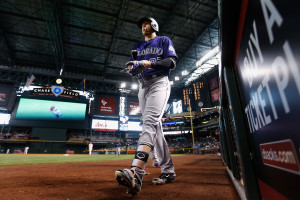
Very little was expected of the Colorado Rockies to begin the 2016 season.  Incredibly, even less was expected of their new starting shortstop.

It was not unexpected that Trevor Story would begin the season as the team’s shortstop.  Last year’s Opening Day starter was Troy Tulowitzki; he was dealt to the Blue Jays at the trade deadline for fellow shortstop Jose Reyes.  Reyes, though, was arrested in the offseason on a domestic violence charge in Hawaii.

Therefore, it would be Story to fill in for him.  And it looks like he’s done more than just fill in.

The Rockies opened their season on Monday against the Arizona Diamondbacks; the game also happened to be the Diamondback debut of ace Zack Greinke.  In a stunning turn of events, Greinke imploded, giving up seven runs in just four innings in one of the worst starts of his career.

As for Story, he would ground out to third in the first at-bat of his career.  In his second one, however, he would take the $206.5 million dollar man over the right field wall.

A home run in your first career game?  That’s great!  It can’t get much better than that, can it?  Oh, yes it can.

And yes, it did get better for Trevor Story on Monday night. In the fourth inning, he would take Greinke deep again for home run number two on the night and in his young career.

So in the first three Major League at-bats of his life, Trevor Story hit a home run in two of them.  Essentially, he played MLB 16: The Show on the easiest difficulty setting.  And he would come close to repeating his performance one night later.

In the fourth inning of Tuesday night’s game, Story stepped in to face the Diamondbacks’ other newly-acquired mound presence, Shelby Miller.  On the second pitch of the at-bat, he would step out in the form of a 436-foot home run to left center field.  In an extremely pedestrian performance, it would be his only home run of the night (that’s sarcasm).  The team would lose 11-6, but no one really cared. This was and is a story about Trevor.

But for as great as Story’s first two games were, could he make history and become the first player to ever hit four home runs in his first three big league games?  We got our answer on Wednesday; it was in the affirmative.  Story would hit a 434-foot homer to almost the same place he hit Tuesday’s dinger.  In the process, he made MLB history and went to a place no rookie had ever gone before.

And then he took it one step further.  In Friday night’s game, Story would hit another two home runs, making it six home runs in the first four games of his career.  He was on pace for 243 home runs, a pace that some would argue is unsustainable (obviously).  The historic, unprecedented four-game run marked the first time in which a player hit a home run in each of his first four games.  The streak would end on Saturday only to continue when Story hit a home run the next day in a win over the Padres.

So, to recap: seven home runs, six games.  And if you lost track, it’s just fine; this Vine will help you avoid making that mistake (h/t Matt Allaire):

But here’s the problem: can he keep it up?

Clearly, his current pace is utterly unsustainable.  The home run record for a single season is 73; Story is on pace for 189.  There’s no way on the planet that Trevor Story (or anyone else in the sport) even comes close to that figure.  But can he hit 30 longballs?  35?  Those amounts would seem a little more reasonable, but expecting even this may be too much to ask of the rookie.

For example, look into his past.  Not to say that there’s anything wrong with this, but Story’s highest total of regular season home runs in a season is 20; he did this last year in half a season in AA and AAA each.  He’s a good hitter, having hit .279 in the minors last season, but he has never hit more than 20 bombs in a single season.  Therefore, asking him to hit 30, never mind 40 or 50 like some have speculated, is likely a little too much.

Also, there’s a chance that Story doesn’t pan out at all.  When he began the season on his absurd tear, the first two players who entered the minds of many were Chris Shelton and Kevin Maas.  Maas was the Yankees’ first baseman who, at the beginning of the 1990 season, hit ten home runs in his first 72 at-bats.  He would be out of the big leagues on an everyday basis by 1992.  Similar was the case for Shelton, who hit nine home runs in his first thirteen games as the Detroit Tigers’ designated hitter in 2006.  Shelton would be sent down to AAA at the end of July following a precipitous drop in his production from the start of the season; he would never play a full Major League season in his career.

However, there’s every chance in the world that Trevor Story will turn out to be a good player.  If he continues to hit consistently (even as his power predictably wanes) he will be one of the best shortstops in the game.  His power, though, has been carrying him through the beginning of the season, and he will need to find a more consistent offensive approach if he wants to have a long career in the majors.

With all of this being said, let’s enjoy Trevor Story and his incredible, scorching-hot play while we still can.

It probably won’t last much longer.

Jay Wright, Jumpman, and Jumpers: Final Four Preview

Photo Credit: Charles Rex Arbogast/Associated Press

We’ve made it; it’s time for the Final Four.

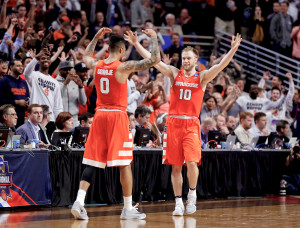
All four of the one-seeds in the big dance made it to the Elite 8; only the North Carolina Tar Heels survived and advanced to play in Houston this weekend.  The Orange of Syracuse are the lowest seeded team remaining (10) and got to the Final Four by way of a stunning comeback win over Virginia on Sunday; they trailed 54-39 with under ten minutes to play and rallied for a 68-62 win.

Villanova and Oklahoma are both 2-seeds who essentially beat chalk on their way to Houston.  With Elite 8 wins over Kansas and Oregon, respectively, both teams advanced and will play each other in the first game on Saturday.

Before we get into the previews, let’s talk a little bit about the venue we’re playing in because it will play a role in the outcomes of the games.

The stadium, then known as Reliant Stadium, served as host of the 2011 Final Four; ironically, this year’s semifinals will take place on the same date as that year’s (April 2).  The four teams remaining at the end of that season (UConn, Kentucky, Butler, VCU) combined to shoot 36.2% on three-point attempts during the regular season.

During Final Four weekend, though, the teams shot just 28.1% (36-128) from deep.  The shooting woes were bookended by Butler’s 12-64 (19%!) performance from the field in the championship game, a 53-41 loss to the Huskies.  The three games were arguably some of the worst in the history of the Final Four.  That’s not all, though.

The stadium also hosted the South Regional’s Sweet 16 and Elite 8 games last year.  The last four teams in the region were Duke, Gonzaga, UCLA, and Utah, a quartet that combined to shoot 38.9% from downtown in the regular season.  But, just like in 2011, the teams struggled from behind the line to the tune of a combined 23-86 in three games.

I get it; shooting in a dome has always been harder than shooting in an arena.  The rim is more difficult to locate at the outset (this sounds like a joke but basketball players who have shot in domes have said as much) and there are more people, A.K.A. more distractions, for a player’s eyes to wander to in the course of a jump shot.  The arrangement is unfair; the NCAA sacrifices the Final Four’s quality of play in order to fit more people into the event.  This is why every Final Four game should probably be in an arena rather than a dome, but don’t hold your breath waiting for this to happen.

With all of this being said, here is a preview of Saturday’s national semifinals.

Semifinal #1: (2) Villanova vs. (2) Oklahoma

Photo Credit: Eugene Tanner/Associated Press

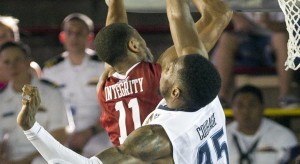
Oklahoma and Villanova actually played each other in the regular season, with the Sooners winning a 78-55 blowout on December 7. The neutral site game was played at Pearl Harbor to commemorate the 74th anniversary of the start of the Pearl Harbor bombing and the beginning of World War II.

While the game was played on a neutral site, Oklahoma and imminent Wooden Award Winner Buddy Hield had no issue finding their stroke from deep.  The Sooners shot 14-26 from downtown; most significantly, Hield and Isaiah Cousins shot a combined 8-13 on threes in the blowout win.  The Wildcats, on the other hand, struggled mightily from behind the arc to the tune of shooting 4-32 on such attempts.

This is the main question with this game: is it more likely that a team shoots 14-26 or 4-32 from three?  Based on the fact that we’re playing in NRG Stadium, I’d say the latter; the dome arrangement does favor one team over the other.

While Nova attempted more threes in the regular season and threes account for a higher percentage of the Wildcats’ shots, the dome favors them because of their excellent defense, which has allowed just 63 points per game in the NCAA Tournament.  In the regular season, do you know how many points the team allowed per game? 63.  It’s serendipity, baby!

Holding Oklahoma to 63 will be a difficult task if only because of the fast pace both teams espouse.  The game will move up and down the floor very quickly and have a lot of excitement.  The catch?  There will be a lot of misses.

You can blame NRG Stadium and the NCAA for that.  However, with the dome on their side and their defense cracking down, I’ll take Ryan Arcidiacono, Kris Jenkins, and the Wildcats to pull the minor upset and advance to Monday night’s title game.

Villanova 71, Oklahoma 65

Semifinal #2: (10) Syracuse vs. (1) North Carolina

Photo Credit: Brett Carlsen/Getty Images

Syracuse shouldn’t be in the tournament. — many analysts

That was the predominant thought when Syracuse got into the NCAA Tournament as a 10-seed, thus completely bypassing the Dayton play-in games reserved for the last four teams in the field.  As for me, I agreed with those analysts: I would have put Monmouth in the dance over the Orange.  However, Syracuse made it, and what has transpired since has validated their existence in the tournament.

That being said, referring to their run as “Cinderella” would be a gross mischaracterization.  After handily defeating Dayton 70-51 in their first-round game, the team destroyed 15-seed Middle Tennessee State and rallied against 11-seed Gonzaga.

However, in the Elite 8, the Orange trailed Virginia 54-39 with under ten minutes remaining.  What happened next may not have been a miracle, but it really felt like one; the team rallied with a 25-4 run and won the game to advance to this weekend’s Final Four.

Syracuse is the underdog in this Final Four, but calling them a “cinderella” is misleading.

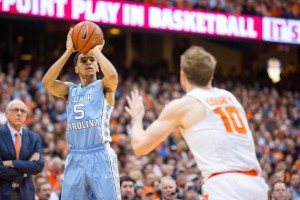
And academic fraud jokes aside, they match up very well with the North Carolina Tar Heels.  Carolina’s biggest weakness in the regular season was three-point shooting; the 2-3 Zone of the Orange is designed precisely to make the opponent shoot threes and keep the ball out of the paint.  With shooting already being a difficult task, the Orange defense may be able to keep the ball out of the hands of Brice Johnson, Kennedy Meeks, and Isaiah Hicks.

That being said, the Heels have turned their biggest weakness into a strength this March.  After shooting 32% from deep in the regular season, the team has improved to 38% from behind in the arc in the NCAA Tournament; this resurgence has been led chiefly by senior Marcus Paige.  I personally jinxed the team last week by saying they are the tournament’s most dangerous team; that’s obviously true now, considering that they are the only one-seed to make the Final Four.

Let’s not forget another thing, too: Syracuse isn’t that much better at making shots, either.  In fact, their shooting percentages are only slightly better than those of the Tar Heels.  Syracuse will try to slow this one down, though, and win the game with their defense.  And they just might pull it off.  The 2-3 Zone is difficult for even the best teams to handle; North Carolina might be the best team in America and even they aren’t immune.  It will be interesting to see if the team can get its big men the ball early in the game to spread out the zone; this is likely the biggest key to victory for both teams.

And if North Carolina can do this, they should be able to win.  If the swarming defense of the Orange is able to keep the Tar Heels far away from the basket, I don’t just believe they can win.  I think they will.  Either way, this game is probably the better of the two semifinal tilts and has the potential to be a thriller.

But my bet is on the Heels to shoot just well enough to win and advance to Monday night’s championship game.

North Carolina 69, Syracuse 66

Please let me know what I got right and wrong in the comments section!

The Real Issue Plaguing Women’s College Basketball

Photo Credit: Jessica Hill/Associated Press

Just when people say you can’t, you can… — Jim Nantz

Those words were uttered by Nantz at the end of Connecticut’s win over Duke in the 1999 men’s basketball national championship game. Amazingly, they still apply today.

On Saturday afternoon, the UConn women’s basketball team resumed its conquest of women’s college basketball with a 98-38 slaughter of Mississippi State for its 72nd consecutive win (the team beat Texas on Monday and extended its win streak to 73).  Honestly, the game wasn’t even that close; the halftime score was 61-12.  61-12.

After the game ended, Boston Globe columnist Dan Shaughnessy, who has written and said ridiculous things in the past, tweeted this thought about the team:

In the span of 137 characters, Shaughnessy somehow does the impossible: he simultaneously has a point and completely misses the point.  He is correct in saying that the overall dominance of one team and one program is detrimental to the game.  And yet his attribution of the killing of the women’s game to the UConn women is completely reckless.  In fact, it completely misses the real source of the sport’s lopsidedness:

The other 348 Division I women’s basketball programs.

To show you the talent disparity between UConn and every other team in women’s basketball, these are the winners of the women’s tournament since 1995 (Geno Auriemma’s first national championship):

  1. Connecticut (1995, 2000, 2002, 2003, 2004, 2009, 2010, 2013, 2014, 2015)
  2. Tennessee (1996, 1997, 1998, 2007, 2008)
  3. Baylor (2005 and 2012)
  4. Maryland (2006)
  5. Notre Dame (2001)
  6. Purdue (1999)
  7. Texas A&M (2011)

Meanwhile, these are the squads that have accomplished the same feat on the men’s side:

  1. Connecticut (1999, 2004, 2011, 2014)
  2. Kentucky (1996, 1998, 2012)
  3. Duke (2001, 2010, 2015)
  4. North Carolina (2005 and 2009)
  5. Florida (2006 and 2007)
  6. Arizona (1997)
  7. Kansas (2008)
  8. Louisville (2013)
  9. Maryland (2002)
  10. Michigan State (2000)
  11. Syracuse (2003)

Notice just how much more parity there is in men’s college basketball. But why is there such a difference in the competitive balance of the men’s and women’s games?

In reality, the problem with one team dominating the sport isn’t that team’s fault; if you don’t like it, beat them (good luck with that).  As a fan, it’s nice if you want parity in the sport but you have to understand that parity can only be attained if many of the best teams in the sport have similar levels of talent.  This parity was attained in men’s basketball this season because many of the best teams were similar and unable to distinguish themselves.

If you wanted to make the argument, though, that UConn is and has been on a different level because of Breanna Stewart, one of the best women’s basketball players ever, that would seem fair.  But every school had a chance to sign her coming out of high school; few actually attempted to earn the right to her services.  Such is the case with Moriah Jefferson and basically any other player on the team. There is a wealth of talent in Storrs and a dearth of talent everywhere else; 348 coaches can look in the mirror for an explanation why.

But maybe these coaches would receive better results if their athletic departments invested more in them and their teams.  Here is some data from Joe Mussatto of the Scripps Howard Foundation Wire about pay disparities between men’s and women’s coaches at certain schools:

The Scripps Howard Foundation Wire pulled 2013 data from 65 schools, all members of the Power Five conferences and Notre Dame, to conduct its research.

Coaches of women’s teams average less than one fourth of men’s team head coaches’ salaries. Texas and Vanderbilt have the biggest discrepancy, but no school pays women’s team coaches more than men’s team coaches.

No school in the entire country pays women’s coaches more than men’s coaches.  Let that sink in and then consider the ridiculousness in that occurrence.

For example, consider the University of Tennessee.  The Volunteers had one of the best women’s coaches of all-time in Pat Summitt; Summitt stepped down after the 2011-12 season after being diagnosed with early-onset Alzheimer’s Disease.  Summitt, a winner of eight national championships and coach of eighteen Final Four teams, was paid an annual base salary of $325,000, with the potential to earn around $1.5 million with incentives.

On the other hand, Tennessee’s men’s basketball program hired Donnie Tyndall from Southern Mississippi in 2014.  His six-year contract called for an annual salary of $1.6 million.  The best part? Tyndall went 16-16 in his first year on the job.  Better yet, he was fired after the season for financial aid violations he had committed in his time at Southern Miss.  Not exactly equal pay based on merit.

Another example of an unjust pay disparity takes place, ironically, at the University of Connecticut.  Geno Auriemma, the greatest women’s coach in the history of the sport, earns around $2 million per year. His counterpart on the men’s side, Kevin Ollie, makes a full $1 million more than him.  Ollie is making that amount based on his team’s 2014 national championship.  That run, however, was fueled by star point guard Shabazz Napier; without him, the team likely would have been bounced in the first weekend of the tournament.

Besides the 2014 run, Ollie has made the NCAA Tournament once in his four-year UConn career.  A recap:

  • Auriemma: 10 national titles, 16 Final Fours, $2 million salary
  • Ollie: 1 national title, 1 Final Four, $3 million salary

Sure, that’s fair.  Actually, it’s completely inexplicable.

That being said, should you be interested in the Women’s Final Four, even if you and everyone else watching probably know the final outcome?  Yes, you should.  While the Huskies have been the predominant team in women’s college basketball over the last two decades, teams like this year’s squad don’t come around very often. Geno Auriemma’s team is a special group, one of the best in the history of the sport.  So yes, there is plenty of intrigue to the Women’s Final Four, even if the outcome is inevitable.

But how can the women’s game avoid lopsided seasons like this one in the future?  Even though there is nothing the NCAA can (or should) do about competitive balance, the other major schools in the sport can do something very easy and simple: invest time and money in their programs.  It really isn’t that difficult, but few schools actually do this.  Other than Auriemma, only four other women’s coaches make more than $1 million per year.  If more universities invested money in their coaches, the likes of UConn would face stiffer competition and parity in women’s college basketball would greatly improve.

But the chances of this happening are very slim.  The sad part is that aside from UConn, the Women’s Final Four is very balanced with a 2-seed (Oregon State), a 4-seed (Syracuse), and a 7-seed (Washington). If there were no dominant team, this Final Four would have the potential to be as interesting, if not more so, than its men’s counterpart.  There is a dominant team, though, and it’s UConn.

Which is okay.  But that there isn’t anyone to get in the way shouldn’t be; it’s up to 348 Division I programs to change that.  In the meantime, let’s lay off the Huskies for being so amazingly good.

Actually, let’s give them the appreciation they deserve as one of the best college basketball teams ever.

This One’s For North Carolina: The Case for the Tar Heels

Photo Credit: Streeter Lecka/Getty Images

North Carolina can’t shoot.  North Carolina can’t pull away on the scoreboard.  North Carolina can’t dominate.  North Carolina can’t win a national championship.

These and other comments were made by myself and many others in the buildup to this year’s tournament.  Sure, the Tar Heels are extremely talented, but could they put everything together and make a deep run this month?  Many people, including yours truly, said the answer would be no.  In actuality, we got our answer last night, and it’s an absolute and definitive yes.

Going into the Sweet 16, the most-anticipated matchup had to have been the Tar Heels against the Hoosiers of Indiana.  It looked as if Indiana’s three-point shooting and ability to run the floor would make the game close; as it turned out, North Carolina’s ability to do both of these things is what would make the contest a blowout.

After dropping a cool 101 points on the Hoosiers, Carolina will face ACC foe Notre Dame on Sunday night for a chance to go to the Final Four.  But why in the world are the Tar Heels playing their best basketball of the season at the best possible time?  What changed from the regular season?

Truthfully, not a lot changed.  What did change was our perception of the Tar Heels and their ability to play with any team in the country.  What also changed was the play of senior point guard Marcus Paige.

Paige followed an extremely impressive sophomore season with disappointing seasons in his junior and senior years.  This season, in fact, may have been the worst of his four-year college career; his shooting percentages and scoring numbers regressed to freshman year levels.  His senior campaign became one mega-sized shooting slump, and he would need to seriously turn things around if the Tar Heels were to be a serious national championship contender.

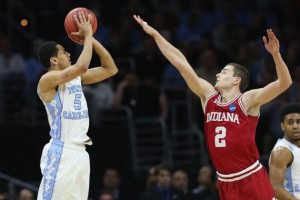
And turn things around he would.  After shooting just 34.6% from deep in the regular season and 6 for 19 in the ACC Tournament, the senior has reversed course and shot 11 for 21 in the Tar Heels’ three NCAA Tournament games.  He started the Indiana game by making his first four shots within the first five minutes…. and all of them were from deep.  His reversal of course has keyed North Carolina’s success in the tournament, but the team still has its work cut out for it to win a championship, even with Paige playing like this.

To start, the Heels will have to contend with the Fighting Irish of Notre Dame in the Elite 8.  Even though the Irish have had a relatively easy road to this point with wins over 11-seed Michigan, 14-seed Stephen F. Austin and 7-seed Wisconsin, they have shown resolve, toughness, and tenacity in these three wins.

In the team’s Round of 32 game against the Lumberjacks, Notre Dame was down a point in the final seconds.  This miraculous tip-in from Rex Pflueger won the game and sent the Golden Domers to the Sweet 16:

After that game, the Irish were forced to contend with the Badgers of Wisconsin.  A late Vitto Brown three would give the Badgers a three-point lead; that shot would be quickly followed by a layup by Notre Dame’s star point guard, Demetrius Jackson.  Subsequently, the Irish would get a steal and another layup from Jackson, jump-starting an 8-0 run over the span of fewer than 20 seconds.  The game ended on that note and Notre Dame advanced to the Elite 8.

However, the Heels match up very well with the Irish.  The teams played once in the regular season, which resulted in an 80-76 Notre Dame home win.  With all due respect to the regular season, that game can be effectively thrown out the window now; the one meeting that was important between the two squads was their ACC Tournament semifinal game.  North Carolina won that contest by 31, and there were times in that game when it wasn’t even that close.

The main thing to watch in this contest will be the effectiveness of Notre Dame center Zach Auguste against the front line of North Carolina.  If Auguste can be effective and cause havoc on the glass, the Irish will have a chance.  If Carolina’s front line of Brice Johnson, Kennedy Meeks and Isaiah Hicks can control Auguste inside, it could, and probably will, spell doom for Notre Dame.  Either way, that matchup will likely be the main determiner of this game.

If the Tar Heels are lucky enough to beat the Irish, they would play either Syracuse or Virginia in the Final Four.  Carolina beat Virginia to take the ACC Tournament but lost to the Cavaliers in late February. On the other hand, Roy Williams’ team beat the Orange of Syracuse both times the teams played in the regular season.

The most interesting part of a potential Syracuse-North Carolina matchup, though, could be its off-the-court storylines, as Jon Solomon of CBS Sports notes:

Still, North Carolina would match up well with the Orange; the problem Syracuse presents is its famous 2-3 Zone, which has held teams to just 53.6 points per game in the NCAA Tournament.  Virginia, on the other hand, would attempt to beat Carolina by slowing down the pace.  If the Tar Heels can play their up-and-down style of play, their chances of beating the Cavaliers are exponentially better.

But those are hypothetical matchups.  North Carolina can beat any one of the seven teams left in the tournament because they can win in so many different ways.  They have found an extra gear this month, finding its outside stroke in the second season.  This ability to shoot the deep ball also helps Carolina’s big men indirectly, giving them more room to operate in the paint and control the boards.

This is why North Carolina is the most dangerous team remaining in the NCAA Tournament.  There are times when they aren’t clicking and very beatable, but they haven’t had many of those times in this tournament.  If they continue their virtually flawless recent play, they’ll be cutting down the nets after the national title game in Houston.

So come on and raise up, Carolina fans; this one’s for you.